 Thaizo
🗓️ October 24, 2026
📍 Japan
🇯🇵 Japan Changes Its Imperial Family Rules! 👑 What It Means for the Royal Family and the Future of the Throne
Japan has officially introduced revised rules governing its Imperial Family. The goal is to address a growing concern: the number of people in the Imperial Family is declining, raising questions about who will carry out royal duties and how the throne will be passed down in the future.
The new law introduces two important changes:
But what does adopting distant relatives into the royal family actually mean? Why did some branches lose their royal status in the first place? And could Japan eventually have a female Emperor?
Let's break it all down! 😊
👑 1. Why Is Japan Changing Its Imperial Family Rules?
Japan's Imperial Family is the country's royal family, headed by Emperor Naruhito.
Its members perform official duties, attend national ceremonies, welcome foreign dignitaries and represent Japan at public events.
However, the number of Imperial Family members has been shrinking. This creates two major concerns:
The revised law attempts to address these challenges while maintaining Japan's existing approach to male-line succession.
To understand one of its most unusual provisions, however, we need to travel back to 1947. 🕰️
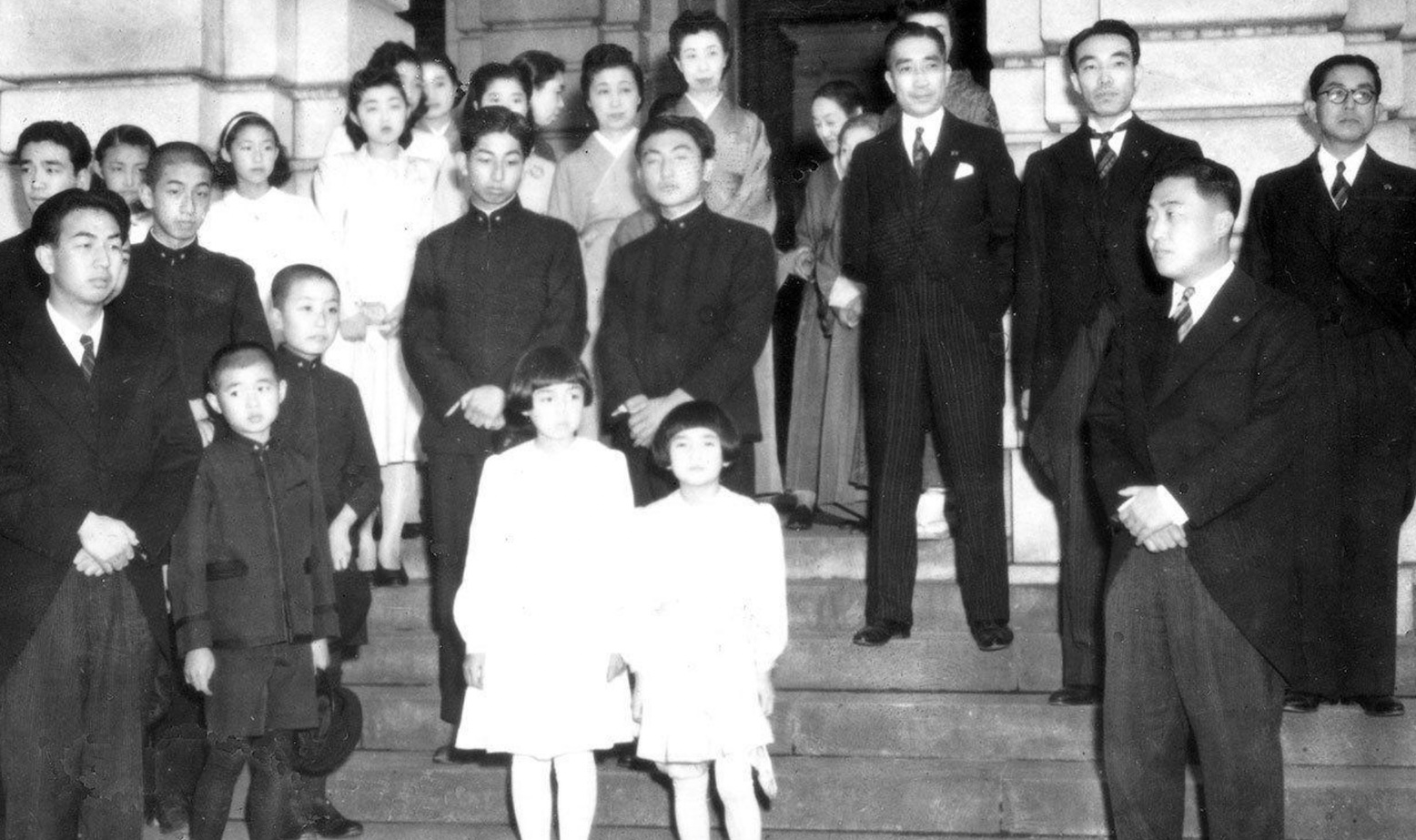
This decision left only Emperor Showa's family and the three princely houses of his younger brothers — Chichibu, Takamatsu, and Mikasa — as the remaining members of the Imperial Family. Those who left the Imperial Family attended a farewell dinner at Akasaka Palace in Tokyo on October 18, 1947. © Kyodo News
📜 2. What Happened in 1947? Why Did 11 Royal Branches Lose Their Status?
After World War II, Japan underwent major political and constitutional changes.
As part of the postwar reforms, the Imperial Family was dramatically reduced in size. On October 14, 1947, 11 branches of the extended Imperial Family lost their official royal status, and 51 people became ordinary citizens.
These were not 11 unrelated families. They were extended branches of Japan's Imperial family tree, with historical connections to the main royal line.
The changes were part of a broader effort to reduce the size and cost of the Imperial household under Japan's new postwar system.
🌳 Imagine the Imperial Family as a Family Tree
Before the reforms, the wider Imperial household included the main royal line and several extended branches.
In 1947, the main Imperial household remained, but 11 extended branches were removed from the official Imperial Family.
🏯 The Japanese Imperial Family
The people affected did not suddenly lose their ancestry. Instead, they lost their legal status as members of the Imperial Family and became ordinary citizens.
Their descendants continued to live outside the official royal household in the generations that followed.
🤔 Why Does This Matter Today?
Because those descendants still have historical family connections to Japan's Imperial line.
Under the revised law, certain male descendants of these former branches could potentially be adopted into the present-day Imperial Family.
In simple terms, Japan is considering bringing some distant relatives back into the official royal household after their branches were removed from it nearly 80 years ago.
Important: This does not mean all 11 branches will be restored. The proposal concerns certain eligible male descendants.
👨👑 3. Could Distant Relatives Become Members of the Imperial Family Again?
Yes, potentially — but there are strict conditions.
The revised law allows eligible male descendants of the former Imperial branches to be adopted into the official Imperial Family.
To qualify, a person must:
Experts cited in the report estimate that approximately 10 people from four of the 11 former branches may qualify.
👑 Does Adoption Mean Someone Automatically Becomes Emperor?
No!
There is an important difference between becoming a member of the Imperial Family and becoming the Emperor.
Adoption could increase the number of official male family members, but it would not automatically make an adopted person Emperor. The rules governing succession would still apply.
🕰️ Why Is the Proposal Controversial?
The common male-line ancestor shared by the current Emperor's line and the descendants of the former branches lived roughly 600 years ago, during Japan's Muromachi period.
That is a very distant family connection!
Some opposition politicians have argued that these descendants are practically strangers to the present Imperial Family.
Others have questioned whether selecting people based on their family origins could raise constitutional concerns.
There is also a practical question: Will any eligible descendants actually agree to be adopted into the Imperial Family?
As of the report, it remains unclear whether anyone will come forward.
💍 4. What Happens When a Japanese Princess Marries an Ordinary Citizen?
The second major change concerns female members of the Imperial Family.
Under the previous rules, female Imperial Family members generally lost their royal status when they married someone outside the Imperial Family.
The revised law introduces a transitional arrangement allowing current female members to choose whether to remain in the Imperial Family after marriage.
But there's a catch: their husbands and children would not automatically become members of the Imperial Family.
👸 Here's How It Could Work
Imagine a Japanese princess marries an ordinary citizen and chooses to remain a member of the Imperial Family.
In other words, a princess could remain a royal while her husband and children remain outside the official Imperial Family.
This creates an unusual situation in which members of the same immediate family have different legal statuses.
🏠 What Practical Questions Remain?
The government still needs to work out several details, including:
These questions have not yet been fully resolved.
🗳️ 5. Could Different Family Statuses Create Political Complications?
Potentially, yes.
Female members who retain their Imperial status do not have the right to vote or stand for election. Their husbands and children, however, would remain ordinary citizens and retain those political rights.
That creates a difference between the rights of a female royal and those of her closest family members.
Some have raised concerns about how this arrangement might affect the Imperial Family's political neutrality.
The government has stressed that it will respect the free will of those involved when implementing the new system.
Chief Cabinet Secretary Minoru Kihara said the government would take appropriate steps while giving due consideration to the people affected.
There is also a personal dimension: although female royals can choose whether to remain, they may feel pressure because their decisions will attract public attention and scrutiny.
So, while the new arrangement offers an additional choice, it could also create difficult decisions for individual family members.
👸 6. Could Japan Eventually Have a Female Emperor?
This is one of the biggest questions surrounding the future of Japan's monarchy.
But first, it's important to understand that allowing a princess to remain in the Imperial Family is not the same as allowing a woman to become Emperor.
These are two separate issues.
Nor does allowing a female royal to remain in the family automatically make her children eligible to inherit the throne.
The debate over female Emperors therefore remains open, alongside questions about gender equality and the long-term stability of the Imperial succession.
🏯 7. What Has the Japanese Government Said?
Prime Minister Sanae Takaichi visited the Imperial Palace in Tokyo on Friday to brief Emperor Naruhito on the revised law.
Chief Cabinet Secretary Minoru Kihara said the government would implement the new system appropriately while respecting the wishes of those involved.
Japan's parliament has also called for continued consideration of measures to ensure stable Imperial succession.
However, opposition parties have called for an expert panel to examine the issue, while Kihara said the government has no immediate plans to establish one.
This means the new law is now in effect, but discussions about the Imperial Family's long-term future are far from over.
🎯 8. The Big Picture: What Does the New Law Actually Change?
🇯🇵 The Takeaway: Japan Is Trying to Balance Tradition With the Future
Japan's revised Imperial House Law attempts to address the shrinking Imperial Family in two main ways.
First, it gives current female royals a choice about remaining in the family after marriage.
Second, it creates a possible route for eligible male descendants of former Imperial branches to join the official royal household through adoption.
The history behind the second measure is particularly important: the 11 branches were not random families. They were extended branches of the Imperial family tree that lost their official status during Japan's postwar reforms in 1947.
Now, nearly eight decades later, some of their descendants could potentially become official members of the Imperial Family again.
However, major questions remain. Will any eligible descendants agree to join? How will families navigate different legal statuses? And will Japan eventually reconsider whether women should be allowed to inherit the throne?
The law has changed, but the debate over how to preserve Japan's Imperial tradition for future generations is far from over. 👑🇯🇵