 Thaizo
🗓️ October 19, 2026
Bangkok Is Getting a Rail Makeover: Two Big MRT Projects Target 2030
Bangkok traffic can test anyone’s patience. One minute you’re heading out for a quick trip; the next, you’re watching the clock while the cars barely move.
But there’s good news for the city’s commuters. Bangkok’s rail network is preparing for a major upgrade, with two important projects aiming to open by 2030.
Bangkok Transport · Thailand InfrastructureAn easy-to-follow guide to the Orange Line, the southern Purple Line extension, construction progress and expected opening dates.
Thailand’s Mass Rapid Transit Authority (MRTA) is working towards opening the full Orange Line and the southern Purple Line extension by the end of the decade.
The exciting part? Passengers could get their first chance to try the eastern Orange Line for free as early as December 2027.
Here’s what is being built, when you might be able to ride it, and why these projects matter for Bangkok.
🚆 Three milestones to remember
Rather than memorising complicated construction details, start with these three dates.
The eastern Orange Line is expected to begin free public trials.
The western section is targeted to open, completing the Orange Line route.
The extension from Tao Poon to Rat Burana is targeted to open.
These are planned dates reported by MRTA, not guaranteed opening dates. The bars above are decorative and do not represent construction progress.
📌 The quick version
December 2027: Free public trials are expected on the eastern Orange Line.
January 2028: Regular fare-paying services are targeted to begin on that section.
July 2030: The western Orange Line is expected to open.
November 2030: The southern Purple Line extension is expected to open.
🟠 Bangkok’s east–west rail connection is taking shape
Think of the Orange Line as a new east–west link across Bangkok. It is being built in two sections, which means passengers won't have to wait until 2030 to use the entire route before seeing the first benefits.
The eastern section is expected to enter public trials in late 2027. The western section is scheduled to follow in 2030.
🚇 The eastern section: The first to welcome passengers
The eastern Orange Line runs from Thailand Cultural Centre to Min Buri (Suwinthawong).
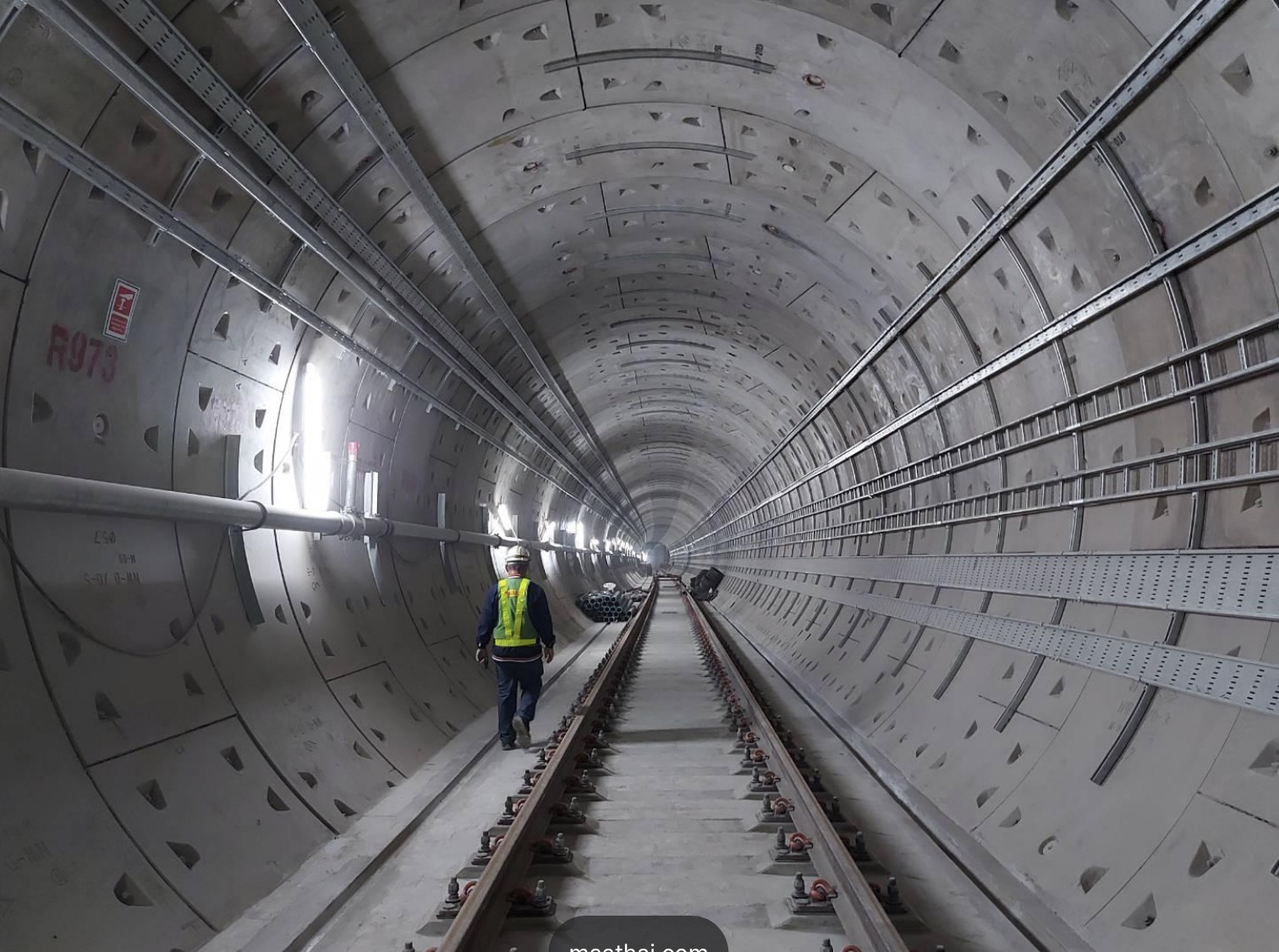
MRTA reported that railway systems work on this section had reached 75.12% completion at the end of September 2026.
📊 Eastern Orange Line progress
The railway systems include the equipment and technology needed to operate the line. Testing must still be carried out before public services can begin.
Progress reported at the end of September 2026.
If the timetable holds, free public trials will begin in December 2027, followed by paid services in January 2028.
That means the eastern section could become useful to commuters well before the full Orange Line is completed.
🏗️ The western section: More work ahead
The western Orange Line will run from Bang Khun Non to Thailand Cultural Centre.
MRTA reported the following construction figures at the end of September 2026:
Western Orange Line progress
The bars are visual approximations of the reported figures. The railway systems percentage is low, so its bar is shown using a minimum illustrative width for visibility.
Construction began on July 31, 2024, following Cabinet approval in January 2020. MRTA is targeting July 2030 for the section's opening.
Once the western and eastern sections are connected, passengers will be able to use the full Orange Line rather than a single section.
🚄 The trains are getting ready for Bangkok
Building tunnels and stations is only part of the job. A railway also needs trains, operating systems and extensive testing before it can carry passengers.
Bangkok Expressway and Metro (BEM), the Orange Line concessionaire, has reported progress on the new trainsets.
🚆 What's happening with the trains?
🔧 What happens after the trains arrive?
The trains and railway operating systems need to be tested in Thailand. This helps ensure that the equipment works together before passengers are allowed on board.
In other words, seeing a train arrive doesn't mean the line is immediately ready to open. There is still important testing to complete.
🟣 The Purple Line is heading south
The other major project is the southern Purple Line extension, which will connect Tao Poon to Rat Burana, near the Kanchanaphisek Ring Road.
The extension is designed to expand the existing Purple Line network and bring rail services to more areas.
📊 Purple Line construction progress
Civil works were 79.35% complete at the end of September 2026.
This figure covers civil works, not the completion of every railway system or the entire project.
🗓️ How did the project get here?
- July 25, 2017: Cabinet approval for construction.
- April 25, 2022: Construction began.
- September 2026: Civil works reached 79.35% completion.
- November–December 2026: MRTA expects to seek board approval for its revised railway-systems PPP proposal.
- 2027: Investor selection and contract signing are targeted.
- November 2030: Planned opening of the extension.
The dates show that the project is not just about building infrastructure. MRTA must also finalise arrangements for the railway systems that will operate the line.
💼 Who will operate the railway systems?
MRTA is revising its public-private partnership (PPP) study for the systems needed to run the extension.
Its preliminary plan is to negotiate a gross-cost PPP arrangement with the existing operator of the northern Purple Line.
Put simply, a PPP is an arrangement in which the public sector works with a private company to deliver or operate part of a project. The exact contractual and payment arrangements matter because they affect how the railway will be managed.
MRTA expects to seek board approval in November or December 2026 before sending the proposal to the Ministry of Transport, the national PPP committee and the Cabinet.
The aim is to select an investor and sign a contract in 2027, helping keep the November 2030 opening target within reach.
👥 How many people could use these lines?
More trains are useful only if people actually use them. MRTA's feasibility assessments estimate how many passenger trips the projects could attract in their opening years.
Entire Orange Line
Estimated daily passenger trips in the opening year of the complete route.
Southern Purple Line extension
Estimated daily passenger trips in the extension's opening year.
📌 What do the numbers tell us?
The full Orange Line is forecast to attract more than twice as many daily passenger trips as the southern Purple Line extension in its opening year.
These are projections from feasibility studies, not guaranteed passenger numbers. Actual usage will depend on factors such as service quality, connections, fares and where people live and work.
A passenger trip is not necessarily a unique person. One person can make several trips in a day.
📈 What about economic returns?
The feasibility studies also assess the wider economic benefits and direct financial returns of the projects.
🟠 Entire Orange Line
Economic Internal Rate of Return (EIRR).
Financial Internal Rate of Return (FIRR).
🟣 Southern Purple Line
Economic Internal Rate of Return (EIRR).
The financial return figure was listed as unavailable.
These two measures tell different stories.
- EIRR: Estimates the broader economic benefits of a project to society, including benefits that may not directly generate revenue for the operator.
- FIRR: Measures the project's financial return based on its costs and revenues.
A railway can deliver wider public benefits even when its direct financial return is relatively low. However, the figures are estimates based on assumptions and should not be treated as guaranteed results.
🚦 What could the new lines mean for everyday Bangkok?
The real story isn't just about concrete, tunnels or trains arriving from overseas. It's about how people move around the city.
More travel options
New railway connections can give commuters alternatives to road transport, particularly for journeys that fit the new routes.
Better connections
Completing the Orange Line and extending the Purple Line could make more parts of the network accessible by rail.
New opportunities
Improved access may support businesses and make some neighbourhoods more convenient places to live and work.
Potentially less road pressure
If more people choose rail for suitable journeys, the network could help ease some pressure on Bangkok's busy roads.
There is an important caveat: a new railway does not automatically eliminate traffic. The benefits will depend on how well the lines connect with other services, how convenient the stations are and whether the service meets commuters' needs.
💡 The commuter's takeaway
If you live, work or regularly travel near these routes, the most useful date to watch first is December 2027, when free trials are targeted for the eastern Orange Line.
For the full Orange Line and the southern Purple Line extension, the key milestones remain in 2030.
🗓️ Bangkok's MRT countdown to 2030
Here is the timeline in one place, so you don't have to dig through the construction details.
All dates are targets based on the supplied report and may change as construction, testing and approvals progress.