 Thaizo
🗓️ Monday, January 19, 2026
📍 Thailand
🌞 Solar Storm Hits Thailand — What You Need to Know 🚀
A powerful solar storm is currently affecting Thailand 🌍, raising concerns about temporary disruptions to satellites 🛰️, GPS navigation 📍, and aviation communications ✈️. Authorities say there is no danger to public health or household electronics ⚡, but some space-based systems may experience short-term interference.
☀️ What Caused the Solar Storm?
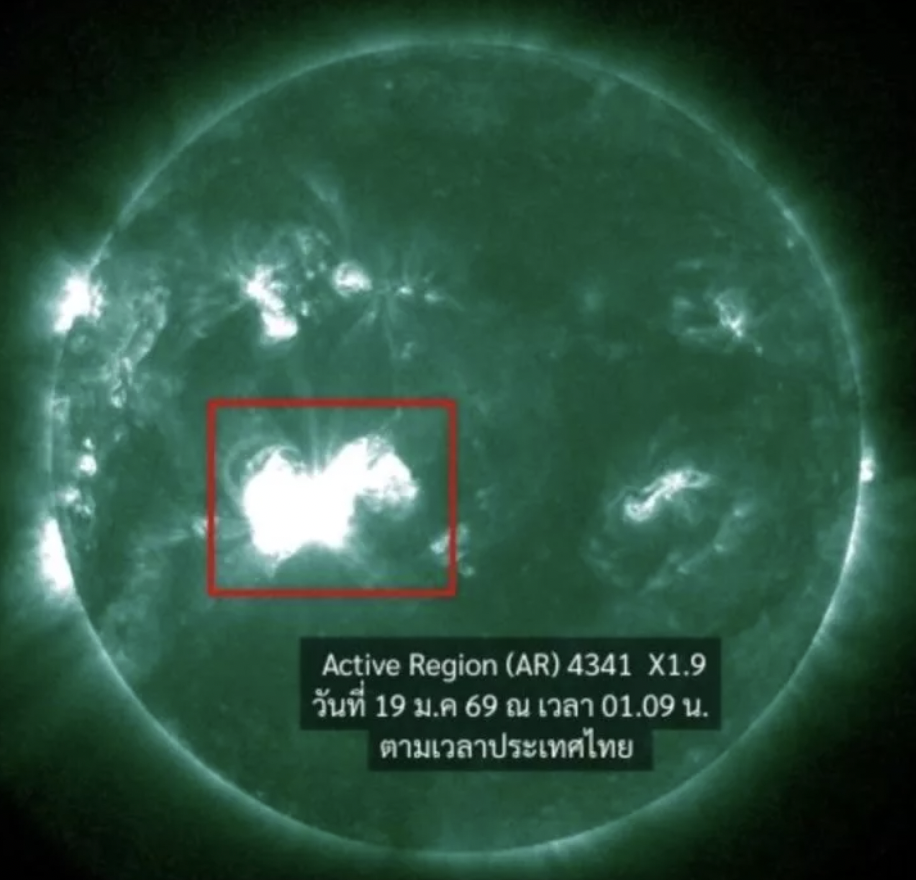
On January 19, 2026, the Sun released an intense X-class solar flare (X1.9) from Active Region 4341 🌞. This powerful eruption sent a massive cloud of charged particles and magnetic fields—known as a coronal mass ejection (CME)—toward Earth 🌎.
The CME, combined with fast solar wind from a coronal hole, struck Earth and triggered a G4-level geomagnetic storm, which scientists classify as severe ⚠️ on the international space-weather scale.
🛰️ Who Is GISTDA?
The situation in Thailand is being monitored by the Geo-Informatics and Space Technology Development Agency (GISTDA) 🇹🇭. GISTDA is Thailand’s national space agency and is responsible for:
📡 Monitoring solar activity and space weather
🛰️ Operating and tracking Thai satellites
🌾 Using satellite data for agriculture, mapping, and disaster management
🚨 Issuing warnings about space-related risks
GISTDA scientists are closely tracking the storm and will provide updates as conditions change 📊.
🌍 What Is a Geomagnetic Storm?
A geomagnetic storm happens when charged particles from the Sun interact with Earth’s magnetic field 🧲. This can disturb the ionosphere, a layer of the atmosphere that helps carry satellite and radio signals 📶.
These storms are not harmful to people or animals 😊 but can affect technologies that rely on space-based signals.
⚙️ Which Systems May Be Affected?
According to GISTDA, the storm may temporarily affect several technical systems:
🛰️ Satellite Operations
Satellites in low Earth orbit may experience increased atmospheric drag, causing them to slow down slightly. Operators may need to make orbital adjustments to keep satellites functioning normally.
📍 GPS and Navigation
Disturbances in the ionosphere can reduce GPS accuracy. This may impact:
🚁 Drones and autonomous systems
🌾 Precision agriculture
📐 Surveying and mapping
🗺️ Geospatial services
Everyday GPS use on smartphones may show minor inaccuracies but should continue working normally 📱.
✈️ Aviation and Radio Communications
High-frequency (HF) radio communications, used in aviation and long-distance flights, may experience brief signal interruptions. Pilots and air traffic controllers are taking extra precautions to ensure safety 🛫.
🔌 Is the Public at Risk?
No. Authorities confirm:
✅ No health risks to people or pets
✅ No damage to household electronics
✅ No threat to Thailand’s power grid or daily services
This is a space-weather event, not a public emergency 🚫.
🔄 How Common Are Solar Storms?
The Sun follows an 11-year activity cycle, and scientists say we are currently in a more active phase 🔁. During this period, strong solar flares and geomagnetic storms become more frequent.
While G4 storms are rare, they are not unprecedented. Modern monitoring and technology help reduce risks and keep disruptions minimal 🧠.
📌 Key Takeaways
🌞 A strong solar storm reached Earth in January 2026
🛰️ GISTDA is monitoring the situation in Thailand
📍 GPS and some satellite systems may be briefly affected
✈️ Aviation communications could see short disruptions
😊 The public and household electronics remain safe