 Thaizo
🗓️ Tuesday, January 6, 2026
📍 Thailand, U.S.
Thailand’s Tilt Toward China Puts U.S. Alliance Under Strain
Overview
Thailand has been a key U.S. security partner for more than seven decades and has a longer history of engagement with Western powers. Over the past decade, however, Thailand has moved steadily closer to China politically, economically, and militarily. Analysts warn that this shift is weakening the U.S.–Thailand alliance and eroding U.S. influence across Southeast Asia.
A Long-Standing U.S.–Thailand Alliance
1833: Thailand (then Siam) became the first Asian country to sign a treaty of amity and commerce with the United States, establishing formal diplomatic and economic relations.
World War I (1917–1919): Siam joined the Allied Powers by declaring war on Germany and Austria-Hungary in July 1917. It deployed the Siamese Expeditionary Force, roughly 1,200 volunteer troops, to Europe, where they served under Allied command in France. After the armistice, Siamese forces participated in the Allied occupation of parts of Germany, making Siam one of the few non-European nations to station troops on German soil. The war elevated Siam’s international standing, secured representation at the Paris Peace Conference, and helped dismantle unequal treaties imposed by Western powers.
World War II (1941–1945): Thailand’s role in World War II was complex and divided. After Japan invaded Thailand in December 1941, Bangkok aligned with Tokyo and declared war on the United States and Britain. Washington, however, refused to recognize the declaration, viewing Thailand as acting under Japanese coercion. Meanwhile, the U.S.-backed Free Thai Movement conducted resistance and intelligence operations against Japan. This dual legacy allowed Thailand to avoid severe postwar penalties and preserved its relationship with the United States.
1954: Thailand joined the Manila Pact and became a founding member of the Southeast Asia Treaty Organization (SEATO), formally aligning with the United States during the Cold War.
Vietnam War: Thailand served as a major U.S. staging ground, hosting American airbases, logistics hubs, and tens of thousands of U.S. personnel supporting operations across Indochina.
2003: Thailand was designated a major non-NATO ally of the United States.
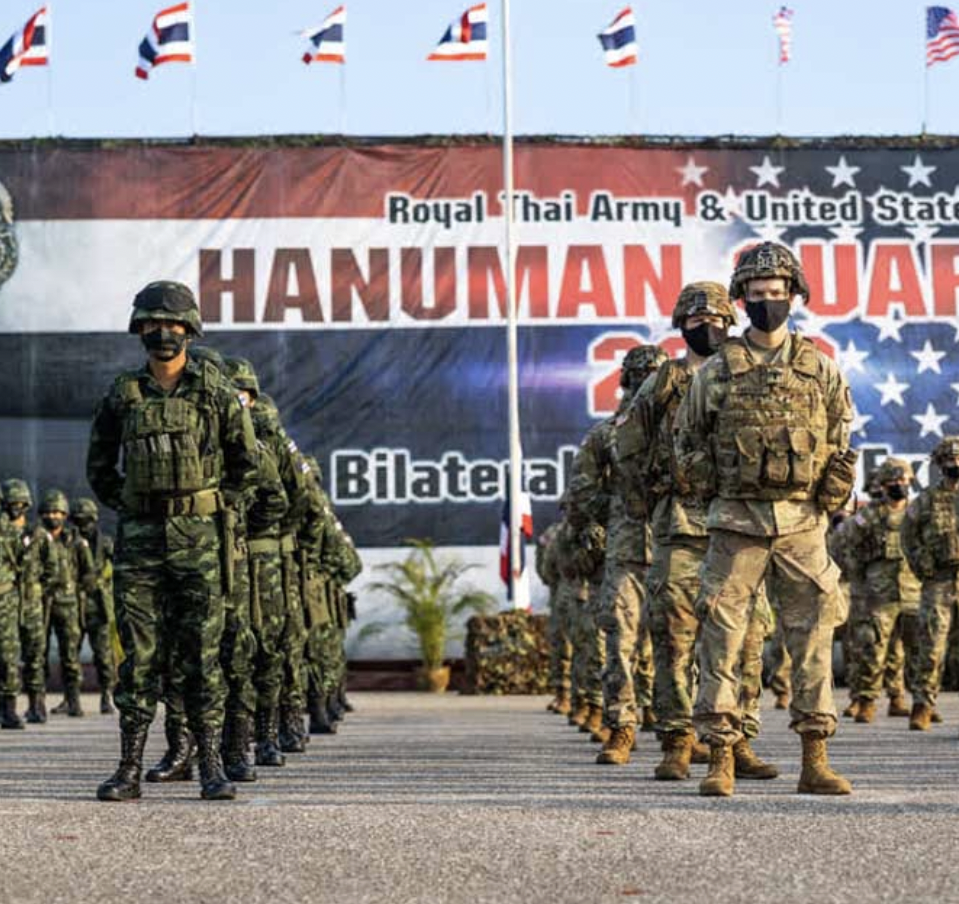
Cobra Gold Exercises: Since 1982, Thailand and the United States have co-hosted Cobra Gold, the world’s largest multinational military exercise.
On paper, this remains one of America’s strongest alliances in Asia.
Thailand’s Growing Alignment With China
Despite its formal alliance with Washington, Thailand has steadily moved closer to Beijing.
Military and Arms Cooperation
After Thailand’s 2014 military coup, the United States reduced military engagement and curtailed some defense cooperation. China moved quickly to fill the gap.
From 2016 to 2022, China sold Thailand nearly $400 million in arms—about twice as much as the United States. Sales included surface-to-air missiles, radars, armored vehicles, and cooperation on Thailand’s first submarine. China has also expanded joint military exercises with Thailand, narrowing the gap with U.S.-led activities.
Strategic Consequences
Analysts say the United States can no longer assume it would have reliable access to Thai military bases during a regional crisis. Thailand is widely viewed as unlikely to permit U.S. forces to operate from its territory during a conflict involving China, including a Taiwan contingency.
Risk of “Decoupling” From the United States
Experts warn the alliance may be drifting toward decoupling, meaning the two countries no longer see their strategic interests as closely aligned.
Possible consequences include fewer U.S. arms sales to Thailand, reduced joint training and exercises, and limited U.S. access to key facilities such as U-Tapao Airfield.
Why U-Tapao Matters
The United States has few operating locations in mainland Southeast Asia. Thailand’s northern position is valuable for logistics and force movement between the Middle East and East and Southeast Asia. Losing access would significantly complicate U.S. regional operations.
Limits on Intelligence and Advanced Technology
Thailand’s closeness to China raises U.S. concerns about sharing sensitive intelligence and transferring advanced military technology.
In 2023, the United States denied Thailand’s request to purchase F-35 fighter jets, reportedly in part due to concerns about Chinese influence. U.S. officials may also avoid certain exercises in Thailand if Chinese surveillance systems could observe American capabilities.
Missile Basing and Regional Defense
A 2024 report by the International Institute for Strategic Studies found that Thailand is highly unlikely to approve U.S. missile deployments on its territory, limiting U.S. options to counter growing missile threats from China and North Korea.
Declining U.S. Focus on Mainland Southeast Asia
As Thailand has leaned toward China, the United States has shifted its strategic focus.
Changing U.S. Priorities
While the 2011 “Pivot to Asia” emphasized Southeast Asia, current U.S. strategy prioritizes the first island chain—Japan, Taiwan, and the Philippines—as well as deeper security ties with Australia, Japan, India, and South Korea. Mainland Southeast Asia now plays a smaller role in U.S. planning.
The Philippines as an Exception
The United States has significantly strengthened military ties with the Philippines to counter Chinese activity in the South China Sea and around Taiwan. Thailand and much of Southeast Asia have increasingly been left on the sidelines.
Shrinking U.S. Influence in the Region
Analysts say the combined effects of Thailand’s pivot toward China, reduced U.S. engagement, and cuts to development and aid programs have sharply reduced American influence.
“The unfortunate byproduct is that U.S. influence has tanked—not only in Thailand, but across Southeast Asia,” said Emma Chanlett-Avery of the Asia Society Policy Institute.
Bottom Line
Thailand remains a U.S. treaty ally in name, but its strategic alignment is increasingly tilted toward China. The U.S.–Thailand alliance is weaker, less predictable, and more constrained than in the past. This shift carries major implications for U.S. military access, intelligence sharing, and regional strategy in Southeast Asia.