 Thaizo
🗓️ October 17, 2026
The World Has a Money Problem, a Jobs Problem — and an AI Plot Twist
World leaders face a perfect storm of rising debt, a looming jobs crisis and artificial intelligence that could change almost everything.
IMF–World Bank Meetings · BangkokAn easy-to-understand guide to the biggest economic challenges facing the world in 2026.
Imagine running a country. Your government owes billions. Young people are struggling to find jobs. Businesses are spending fortunes on AI. Meanwhile, prices remain a concern and global tensions keep shaking the economy.
Welcome to the global economy in 2026.
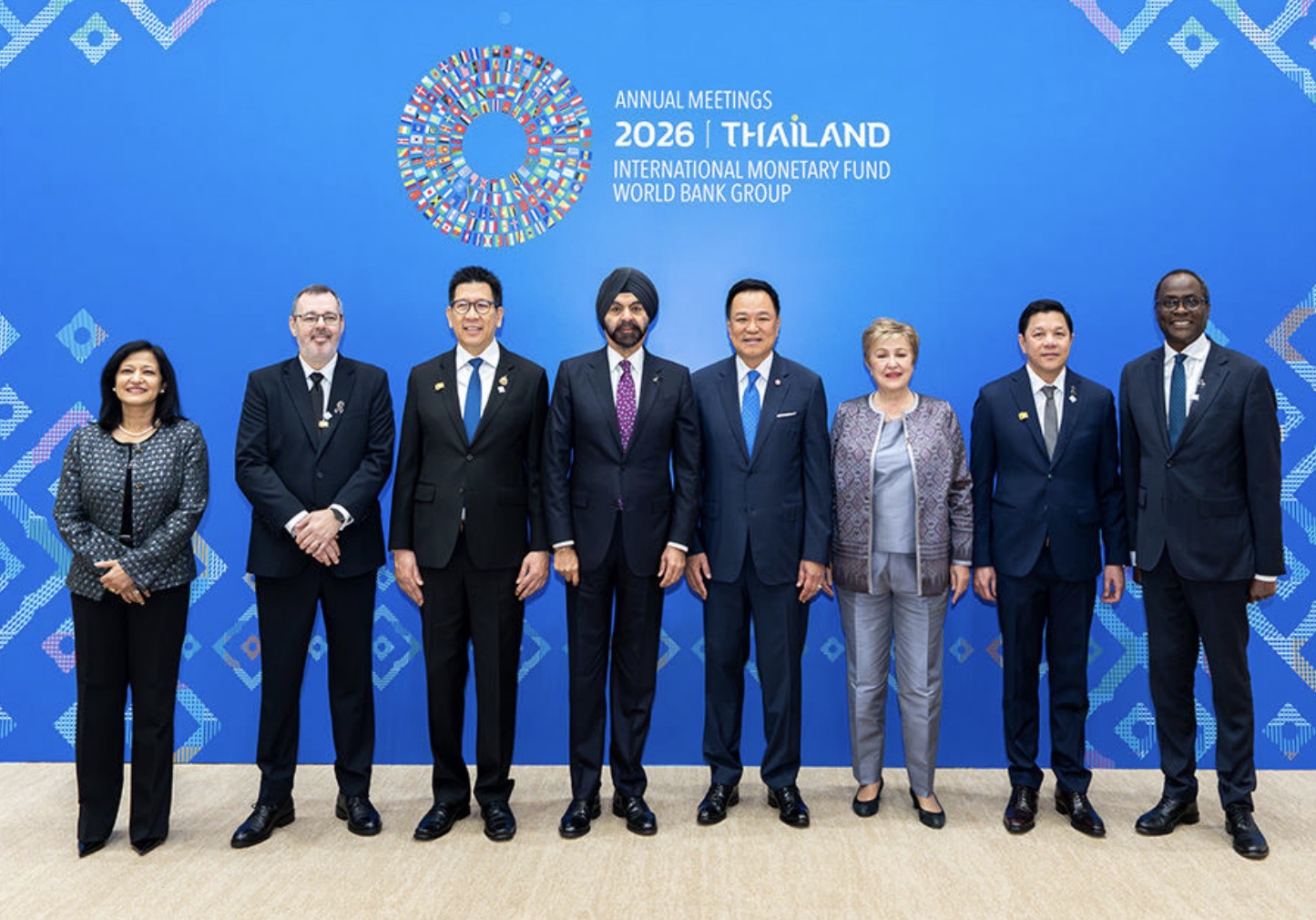
At the IMF–World Bank Annual Meetings in Bangkok, world leaders discussed three enormous challenges: debt, jobs and artificial intelligence.
The big question? Can the world become richer without leaving millions of people behind?
The world economy in three numbers
Three figures help explain why world leaders are concerned. The global economy is still growing, millions of young people need jobs, and AI could change the way we work.
The IMF's projected global economic growth rate for 2026. The economy is moving forward, but risks remain.
The approximate gap between young people entering working age and the jobs expected to be created.
AI could boost productivity, but it also brings uncertainty around jobs, investment and cybersecurity.
📌 What do these numbers tell us?
3.1% growth: The world economy is expanding, but growth alone does not guarantee that everyone benefits.
800 million: The projected jobs shortfall highlights the enormous challenge of creating enough opportunities for the next generation.
AI: Technology could help businesses produce more, but workers and governments must prepare for the changes ahead.
Important: The bar lengths are decorative illustrations, not measured economic percentages. The jobs gap is a projection, not a count of people already unemployed.
💸 Governments are carrying some very heavy baggage
Imagine running a household with a huge mortgage, rising monthly repayments and a list of bills that never seems to end. Now imagine the same problem, but on a national scale.
Governments borrow money to build roads, improve hospitals, invest in education and keep essential services running. Borrowing can be useful when the money creates lasting value.
The trouble starts when interest payments take up so much of the budget that little money remains for other priorities.
📉 How a debt problem can snowball
These bars illustrate a possible chain of events. They are not measurements of actual government debt.
IMF Managing Director Kristalina Georgieva warned that heavy public debt leaves governments with less room to respond to economic shocks.
Her message: countries need to rebuild their financial safety cushions before the next storm arrives.
💡 The balancing act: Spend too much without a plan, and debt can become dangerous. Cut too aggressively, and you risk damaging the economy you are trying to protect.
Why should ordinary people care?
- Higher government borrowing costs can put pressure on public budgets.
- Businesses may face more expensive loans, making expansion harder.
- Governments may have less money available for infrastructure and services.
- Developing countries can be especially vulnerable when international borrowing becomes expensive.
👩💻 Where will 800 million jobs come from?
Here's the number that deserves a double take.
The World Bank estimates that around 1.2 billion young people in developing countries will reach working age over the next 10–15 years.
But current projections suggest that only around 400–420 million jobs will be created.
📊 The jobs challenge, visualised
That's the approximate gap between the number of young people reaching working age and the number of jobs projected to be created.
The bars compare approximate quantities. They do not mean every person without a projected job will be unemployed.
Why is this such a big deal?
Imagine finishing school, earning a qualification and preparing to start your career — only to discover that the economy isn't creating enough opportunities.
The effects can spread throughout society:
- Families: Less income and greater financial pressure.
- Businesses: Fewer customers with money to spend.
- Governments: More pressure to provide support.
- Young people: A harder path towards independence and a secure future.
🎯 A job is more than a payslip. It can mean dignity, independence and the ability to build a future.
🚀 So where could the jobs come from?
🏭 Growing businesses
Help small and medium-sized businesses expand, reach customers and hire more workers.
⚡ Better infrastructure
Reliable electricity, roads and internet help businesses operate and create opportunities.
🎓 Practical skills
Give workers training that matches the skills employers actually need.
💰 Private investment
Encourage investment in productive businesses that can grow and create sustainable jobs.
The World Bank wants governments and private businesses to work together. Public investment can help create the conditions for companies to grow, while private capital can help fund expansion.
The real goal isn't simply to create more jobs. It's to create productive jobs that allow people to earn a decent living.
🤖 AI: The ultimate double-edged sword
Artificial intelligence is no longer just a science-fiction idea. It can write code, analyse documents, generate images, answer questions and automate repetitive tasks.
Businesses are investing billions in AI because they hope it will help them work faster, reduce costs and discover new ways to make money.
But there's a catch: making a business more productive doesn't automatically mean every worker will benefit.
The upside
AI can handle repetitive tasks, help workers analyse information and give small businesses access to tools that were once available mainly to large companies.
Illustrative visual — not a measured productivity score.
The downside
Some tasks may disappear, certain roles may shrink, and workers may need new skills to remain competitive. Cybersecurity risks could also increase.
Illustrative visual — not a forecast of job losses.
💡 The million-dollar question
If AI helps the economy produce more wealth, how do we make sure ordinary workers benefit too?
The answer may involve better training, responsible technology use, stronger education and policies that help workers adapt when their jobs change.
📈 Can AI actually push prices up?
Surprisingly, yes — at least potentially in the short term.
Think of AI as building a huge new factory. Before the factory can produce anything, someone must pay for the building, equipment, computers and electricity.
That's similar to what's happening with AI infrastructure. Companies are investing heavily in data centres, advanced chips, computing power and energy.
This spending increases demand today, even though the productivity benefits may take time to arrive.
🔄 The AI investment cycle
💰 Companies spend big
Businesses invest in AI systems, chips and data centres.
⚡ Demand rises
More computing power and electricity are needed. This can put pressure on limited supplies.
🏭 Businesses adopt AI
Companies begin using AI in everyday operations, from customer service to research.
🚀 Productivity may improve
If the technology works well, businesses may produce more with the same resources and lower some costs.
These bars illustrate the stages of a possible investment cycle. They do not represent actual spending, inflation or productivity measurements.
Over time, AI could help increase the economy's ability to produce goods and services. That may ease price pressures. However, the outcome depends on how quickly businesses adopt the technology and whether the productivity gains are large enough to justify the investment.
🌾 Small AI, big impact
Not every useful AI breakthrough needs to look like a robot from a science-fiction movie.
Sometimes the biggest benefits come from simple tools that help people do everyday jobs better.
For farmers
AI tools could help identify crop diseases, estimate irrigation needs and improve decisions about planting.
For healthcare
AI could help health workers review medical images, organise patient information and support diagnosis.
For small businesses
AI could help forecast demand, manage stock and answer routine customer questions.
For education
AI tutors could help learners practise skills and receive explanations tailored to their needs.
But access matters. People need reliable electricity, internet connections, affordable tools and proper training. Otherwise, AI could widen the gap between wealthy and less-developed communities.
🏦 Why interest rates matter to everyone
Central banks, including the US Federal Reserve, try to keep inflation under control while supporting a healthy economy.
When inflation stays too high, central banks may raise interest rates. Borrowing becomes more expensive, which can cool spending and reduce pressure on prices.
Who feels the impact?
🏠 Households
Loans and mortgages may become more expensive, leaving families with less money to spend elsewhere.
🏢 Businesses
Higher borrowing costs can make companies delay expansion, equipment purchases or hiring.
🌍 Governments
Countries that need to borrow money may face higher interest bills, putting more pressure on public budgets.
This leaves central bankers with a difficult balancing act. They must consider inflation, economic growth, employment, energy prices and the uncertain effects of new technology.
🔐 Don't forget cybersecurity
AI can help people work faster, but it can also help criminals create more convincing scams and exploit weaknesses in computer systems.
Strong passwords, multi-factor authentication, regular software updates and caution with unexpected messages remain important ways to protect yourself.
The lesson is not to fear AI or assume it will solve everything. It's to make the technology useful, secure and accessible — while helping people adapt to change.
🪧 Outside the conference: Growth for whom?
Inside the conference hall, financial leaders discussed debt, investment and economic growth. Outside, civil society groups raised a different question: who really benefits from these policies?
According to the article, more than 2,000 civil society representatives and human rights defenders took part in demonstrations involving national networks.
Protesters criticised international loan conditions, government spending cuts, land rights concerns and development policies they believe can harm local communities and the environment.
Financial stability
The IMF and World Bank emphasise sound public finances, investment and policies that can support long-term economic stability.
Social fairness
Critics argue that economic reforms must protect essential services, local livelihoods, land rights and vulnerable communities.
These concerns highlight a difficult balancing act. Countries need financial stability, but reforms can create real hardship if the costs fall too heavily on people who have the fewest resources.
💬 The question leaders cannot ignore
Economic growth matters — but so does how the benefits are shared. A stronger economy should create meaningful opportunities, not just bigger financial statistics.
🇹🇭 From fax machines to artificial intelligence
Thailand hosted the 2026 IMF–World Bank Annual Meetings in Bangkok, bringing financial leaders together to discuss the future of the world economy.
Prime Minister Anutin Charnvirakul drew on Thailand's history as an international trading centre, recalling how the ancient capital of Ayutthaya prospered through trade and diplomacy.
One comparison stood out: the technology that symbolised speed in 1991 was very different from the technology transforming economies today.
📠 1991 — The age of fax machines
Fax machines and traditional telecommunications represented faster ways to exchange information across borders.
🤖 2026 — The age of AI
AI is changing how companies operate, how people work and how countries compete in the global economy.
🌏 The challenge ahead
Countries must embrace new technology while investing in people, skills, infrastructure and inclusive growth.
The broader message is that countries cannot afford to stand still. But adapting to change means more than buying new technology — it means preparing people to use it and benefit from it.
🎯 Four things worth paying attention to
International economic meetings can sound distant from daily life. In reality, their big themes can affect your money, your career and the opportunities available to your family.
Your money
Inflation, interest rates and government finances can affect borrowing costs, household budgets and public services.
Your career
Learn how AI can support your work. Communication, critical thinking, adaptability and technical skills can help you navigate a changing job market.
Your opportunities
Investment in businesses, infrastructure and education can help create new industries and better jobs.
Your digital safety
Be alert to suspicious links, unexpected payment requests and convincing messages that may have been generated or altered using AI.
📚 About the numbers
This article is based on the supplied report about the October 2026 IMF–World Bank Annual Meetings. Figures described as forecasts or estimates should not be treated as guaranteed outcomes.
The animated bars are illustrative visual elements, not independently measured economic indicators. For publication, verify the figures against the original IMF and World Bank releases.
Economic explainer · October 2026